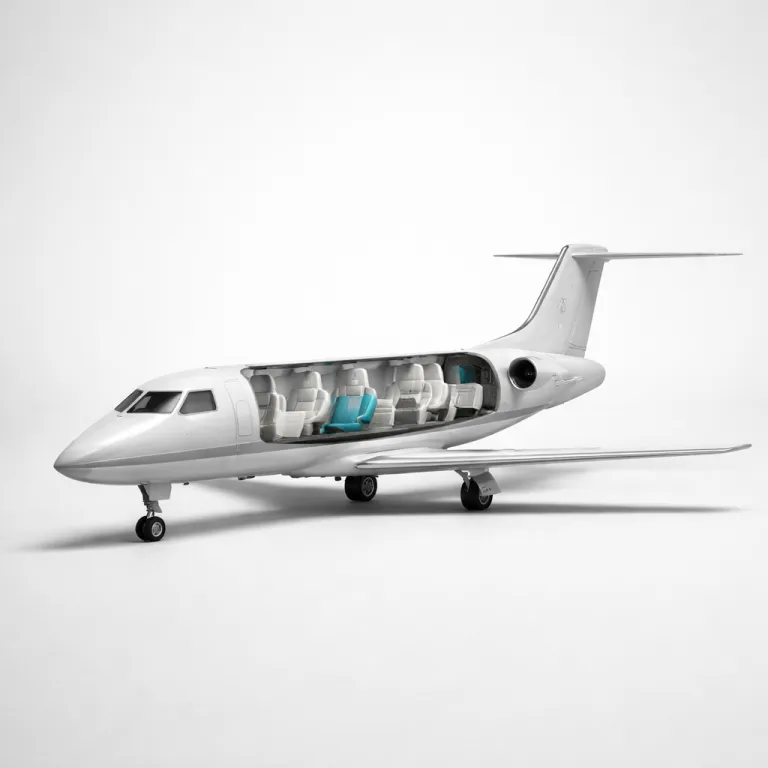
Gulfstream G400 review: positioning this large cabin jet in the real world
The Gulfstream G400 sits between super midsize business jets and the ultra long range flagships. It is a Gulfstream aircraft designed to deliver a genuinely large cabin without forcing you into intercontinental range you will rarely use. For a charter or fractional client flying 50 to 200 hours per year, that balance between cabin size, certified range, and operating price matters more than brochure superlatives.
On paper, this aircraft offers a published range of about 4,200 nautical miles at long range cruise with typical NBAA IFR reserves, based on Gulfstream’s preliminary data sheet and early program briefings. In practice, that assumes standard day conditions, long range cruise Mach, and a typical business jet payload, which makes nonstop flights such as New York to London, São Paulo to Miami, or Paris to Dubai realistic under most NBAA IFR planning assumptions while still carrying a full complement of passengers and luggage. The Gulfstream team clearly targeted operators whose missions are 80 percent domestic or regional, with only occasional transatlantic flight profiles that do not justify a G500 or G600 level of ultra long range capability.
From an aviation strategy perspective, the G400 is Gulfstream’s answer to the Dassault Falcon and Bombardier Challenger families that have long dominated the upper end of the super midsize and entry large cabin categories. Where a Bombardier Challenger 350 or 3500 offers strong performance and competitive Mach cruise figures, the G400 stretches into true large cabin territory with more living areas and a lower cabin altitude. That shift changes how passengers feel after a six hour flight, and it changes how charter clients perceive value when comparing business jets on a broker’s quote sheet.
Cabin and comfort: what you really gain over super midsize jets
The heart of any Gulfstream G400 review is the cabin, because that is where passengers live for hours at a time. This large cabin design is significantly wider and longer than typical super midsize aircraft, and it finally gives you the sense of volume that many Bombardier Challenger and Dassault Falcon operators wish they had on their busiest routes. You feel it the moment you step through the door and stand fully upright, with several extra inches of headroom and more usable feet of floor length for flexible seating layouts.
Gulfstream has carved the interior into distinct living areas, usually a forward club, a mid cabin dining or conference zone, and an aft lounge that can convert to berths on longer flight segments. That three zone approach is what separates true large cabin business jets from stretched super midsize models, because it allows one group of passengers to work while another rests or takes calls in relative privacy. Natural light floods the space through the signature oval windows, and the combination of lower cabin altitude and quiet acoustics reduces fatigue on both short hops and long range missions.
Compared with a super midsize benchmark like the Challenger 300, which many private travellers know from charter, the G400’s cabin gives more shoulder room, more aisle width, and more flexibility for galley and storage options. In day to day use, the extra space means easier movement for crew and passengers, smoother in flight service, and a more relaxed atmosphere when the aircraft is full on a high speed business shuttle. For buyers who want a quick snapshot, the G400’s cabin is closer to traditional large cabin dimensions than to the stretched super midsize category.
To put that into context, the following approximate figures, based on manufacturer data sheets and industry summaries, highlight how the G400 compares with key competitors on headline cabin and mission metrics:
| Aircraft | Typical seating | Cabin length (ft) | Cabin width (ft) | Range (nm, NBAA IFR) |
|---|---|---|---|---|
| Gulfstream G400 | 12–13 | ~36 | ~7.6 | ~4,200 |
| Bombardier Challenger 3500 | 8–10 | ~25 | ~7.2 | ~3,400 |
| Dassault Falcon 2000LXS | 10 | ~26 | ~7.7 | ~4,000 |
Performance, range, and speed: matching missions to the G400
Performance numbers only matter if they align with how you actually fly, and any serious Gulfstream G400 review has to translate range and speed into real missions. The G400’s advertised range of about 4,200 nautical miles at long range cruise gives you transcontinental reach in both North America and Europe, plus transatlantic capability under typical NBAA IFR planning rules. For an owner or program member whose flights are mostly between 1,500 and 3,000 nautical miles, that range and Mach balance is more than sufficient.
At high speed cruise, the aircraft is expected to operate near Mach 0.88, with a maximum operating Mach number slightly higher for flexibility in the flight levels, according to Gulfstream’s preliminary specifications and FAA certification briefings. That high speed capability lets crews shave meaningful minutes off a business flight between city pairs such as Los Angeles and New York, or London and Riyadh, while still preserving enough fuel for IFR reserves under conservative crew NBAA procedures. When you slow to a more economical Mach setting, the long range profile extends, giving dispatchers options when headwinds or payload push against the margins.
The G400 uses modern Pratt & Whitney Canada PW812GA engines, which are designed to balance thrust, fuel burn, and maintenance intervals for demanding business aviation operations. Compared with older large cabin aircraft, the combination of efficient engines and refined aerodynamics should translate into lower operating costs per hour, especially for fleets that standardize on Gulfstream aircraft types. For new entrants stepping up from a light jet such as the Phenom 100, which is often used as a refined entry point to private aviation, the jump in performance, speed, and payload capability is dramatic, but so is the jump in acquisition price and complexity.
Flight deck, Symmetry system, and pilot economics
Behind the curtain, the G400’s Symmetry Flight Deck is one of the most consequential features for operators, and any Gulfstream G400 review aimed at serious buyers must address it directly. The system brings active control sidesticks, extensive touchscreen avionics, and advanced automation from the G500, G600, G700, and G800 into a slightly smaller airframe. For pilots, that means a consistent cockpit philosophy across multiple Gulfstream aircraft, which simplifies training, recurrent checks, and day to day operating procedures.
From a recruitment and retention standpoint, the Symmetry Flight Deck is a selling point in a tight pilot labor market, because crews increasingly prefer modern, integrated avionics over legacy panels. When your fleet uses the same flight deck architecture, you can move pilots between aircraft with less incremental training, and crew NBAA standardization becomes easier to maintain. That has real financial impact for charter and fractional programs that run complex schedules and must keep aircraft available even when one crew times out under IFR duty limits.
For the passenger, the benefits of this symmetry flight environment are indirect but tangible, because better situational awareness and workload management can support smoother, more predictable operations. The aircraft’s systems are designed to support precise NBAA IFR approaches, efficient climb profiles to optimal feet in cruise, and consistent performance in high traffic terminal areas. If you are curious how cockpit design affects solo flying and smaller platforms, a detailed guide on what to know about single seat airplanes offers useful context, even though the G400 itself is firmly a two pilot business jet.
Economics, competitors, and who the G400 really suits
For a charter or fractional client, the key question in any Gulfstream G400 review is not just how the jet flies, but whether the economics make sense compared with other business jets. Acquisition price will sit well above super midsize aircraft such as the Bombardier Challenger 3500, yet below ultra long range flagships like the G700 or Dassault Falcon 8X. Industry estimates suggest a typical new G400 completion will be priced in the mid $30 million range, with direct operating costs often modeled around $5,000 to $6,000 per flight hour depending on fuel and maintenance assumptions.
On a per hour basis, operating costs for the G400 should be higher than those of smaller business jet types, but the cost per seat mile can be competitive when you regularly fill ten or more passengers. For managed fleets and fractional programs, the ability to share pilot pools and maintenance expertise across multiple Gulfstream aircraft types reduces overhead, especially when the Symmetry Flight Deck and Pratt & Whitney engine commonality come into play. The result is a platform that can slot neatly into a tiered fleet, offering a step up from super midsize jets while keeping the ultra long range flagships reserved for only the most demanding long range missions.
The ideal G400 user flies mostly domestic or regional routes, values a genuinely large cabin with distinct living areas, and needs transatlantic capability a few times per year rather than every month. If that describes your pattern, the G400’s blend of range, speed, and comfort may justify the premium over smaller aircraft, while still avoiding the full financial and operational commitment of the biggest long range models. In private aviation, the smartest move is often not the maximum range or the highest speed, but the aircraft that feels exactly right in the first hour at altitude, not the price tag, but the first hour at altitude.
FAQ
How many passengers can the Gulfstream G400 carry comfortably ?
The Gulfstream G400 is typically configured for around 12 passengers in a three zone large cabin layout. High density configurations can seat more, but most business operators prioritize space and comfort over maximum seating. For charter clients, the sweet spot is usually eight to ten passengers with generous legroom and storage.
What is the practical range of the G400 on typical business missions ?
In real world conditions, the G400’s practical range is about 4,000 to 4,200 nautical miles with standard NBAA IFR reserves, based on Gulfstream’s published performance targets and typical long range cruise assumptions. That allows nonstop flights such as New York to London or Paris to Dubai under normal winds. When fully loaded or facing strong headwinds, dispatchers may plan a technical stop to preserve comfortable fuel margins.
How does the G400 compare with super midsize jets like the Challenger 300 ?
Compared with a super midsize aircraft such as the Challenger 300, the G400 offers a larger cabin, longer range, and more flexible living areas. Operating costs are higher, but the cost per seat mile can be attractive when you regularly carry more passengers. For many operators, the decision hinges on whether they truly need the extra space and transatlantic capability.
Who should consider choosing the G400 over a G500 or G600 ?
The G400 suits owners and programs whose missions are mostly domestic or regional, with only occasional long range flights beyond 4,000 nautical miles. If you frequently fly ultra long range routes such as Los Angeles to Hong Kong, a G500 or G600 is a better fit. If your longest regular trips are transatlantic or transcontinental, the G400’s balance of price, performance, and cabin size is compelling.
What are the main advantages of the Symmetry Flight Deck for operators ?
The Symmetry Flight Deck offers active control sidesticks, touchscreen avionics, and a common cockpit philosophy across multiple Gulfstream models. For operators, that means simpler training, easier crew scheduling, and more consistent operating procedures. For passengers, the benefits show up as smoother flights, efficient routing, and fewer delays linked to crew or technical issues.